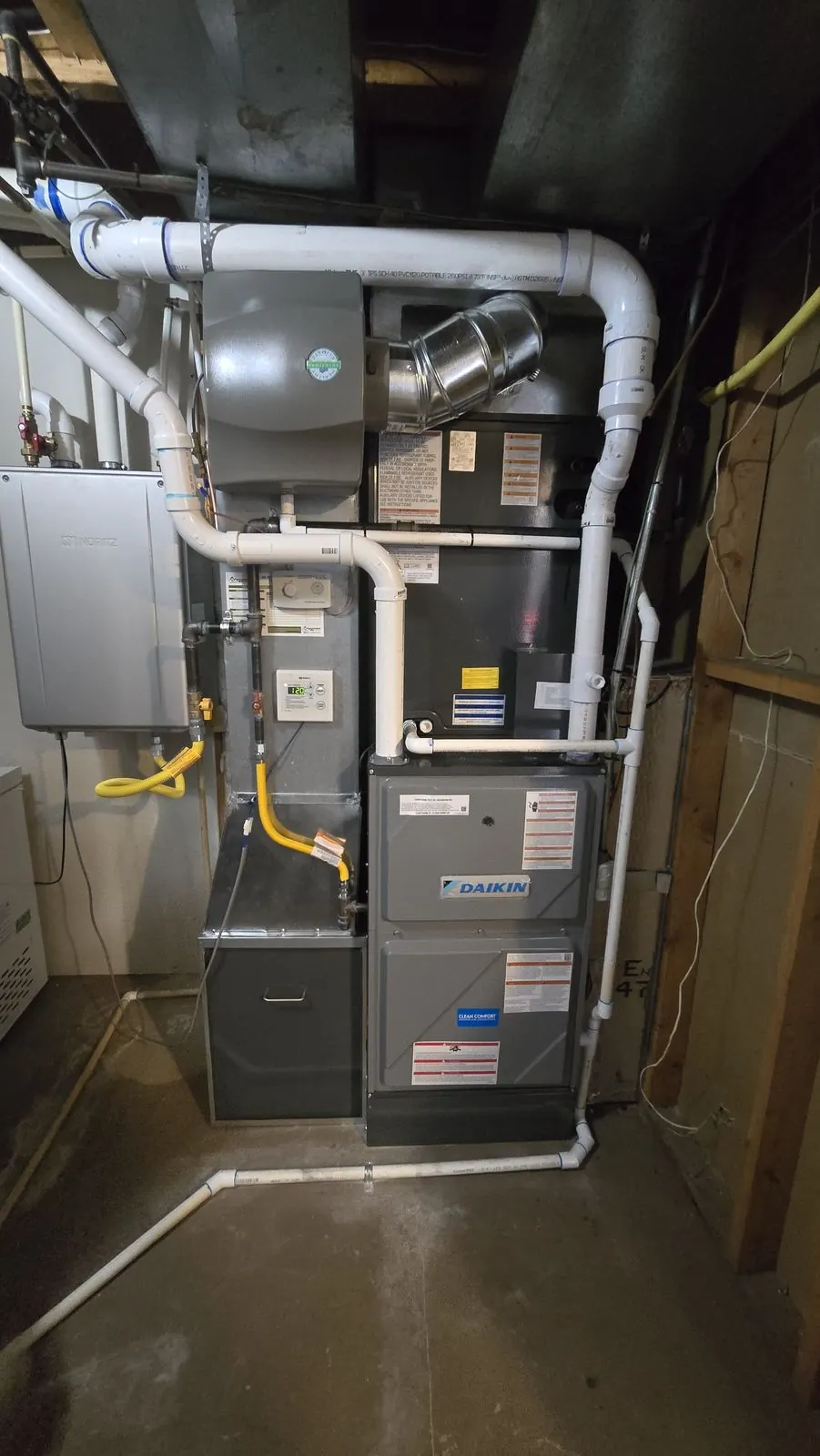
When a furnace breaks down in January, the first question is usually “Can you fix it?” The better question is often “Should we fix it?” Here’s how to think it through, so you can make the call with real information instead of pressure.
Start with the age of the furnace
Most gas furnaces last about 15 to 20 years with regular maintenance. Age alone doesn’t mean a furnace has to go, but it changes the math:
- Under 10 years old: repair is almost always the right move, unless there’s a cracked heat exchanger or a major failure outside warranty.
- 10 to 15 years old: it depends on the repair. A new igniter or flame sensor is a small fix. A failed control board or inducer motor on an older unit is worth a second thought.
- Over 15 years old: start planning for a replacement, even if you repair it this time. That way you replace it on your schedule, not in the middle of a cold snap.
You can usually find the manufacture date on the label inside the furnace door.
A simple rule of thumb: the $5,000 rule
Many technicians use this quick check: multiply the age of the furnace by the cost of the repair. If the number is over about $5,000, replacement is usually the better value.
For example, a $400 repair on a 16-year-old furnace works out to $6,400, so it’s worth getting a replacement quote. A $250 repair on a 7-year-old furnace works out to $1,750, so repairing it makes sense.
It’s not a perfect formula, but it’s a helpful starting point.
Signs a replacement is worth considering
- Repeated repairs. Two or more significant repairs in a couple of years is a sign the furnace is wearing out.
- Rising gas bills without a change in how you use your home.
- Uneven heating that maintenance and filter changes don’t fix.
- Safety concerns. A cracked heat exchanger can let combustion gases into your home. If a technician finds one, replacing the furnace is usually the safe choice. Every home with a gas furnace should also have working carbon monoxide detectors.
- Low efficiency. Older furnaces are often around 80% efficient or less. A modern high-efficiency furnace (95% AFUE or higher) turns much more of your gas into heat, which adds up over a long Utah winter.
When repair is the right call
A good technician should tell you when a repair makes more sense than a new system. Common, reasonable repairs include:
- Dirty or failed flame sensors and igniters
- A failed pressure switch or limit switch
- A clogged condensate drain on a high-efficiency furnace
- Blower motor or capacitor issues on a furnace that’s otherwise in good shape
If your furnace is in decent condition, there’s no reason to replace it early. One of our customers had several companies tell them to replace a system that was only a few years old. We found a repair instead.
Questions to ask before you decide
- How old is the furnace, and what condition is the heat exchanger in?
- What exactly failed, and is it likely to happen again?
- What does the repair cost compared to a replacement?
- If I replace it, what size and efficiency do I actually need for my home?
- Should my AC be replaced at the same time? (If it’s also older, matching the two can improve efficiency and keep warranties simple.)
Get an honest second opinion
At Elevate Heating and Air, we diagnose the problem, explain your options in plain terms, and give you a free estimate on replacement if it comes to that. You decide, with no pressure either way.